Showing posts with label television. Show all posts

Sophie Dahl will make your candle fizz

Visual metaphor of the week goes to the fizzing, spurting candles on TV cooking programme The Delicious Miss Dahl:

spurtinng candles on Sophie Dahl cooking show

(The candles appear at about 15 minutes, 10 seconds in on episode two, 'Romance', which is available to watch on the BBC's iPlayer for the next month.)

Where's rougher than Walford? Balham

EastEnders is set in the fictional East London borough of Walford.

Walford is hardly the most affluent place in the world, but sometimes the scriptwriters need the action to take place in an even rougher, more dangerous part of London - and for that they look south.

One current plotline has several scenes set in the South London neighbourhood of Balham. It is portayed as a wasteland of council flats, dark alleys, and menacing gangs:


EastEnders gang scene set in Balham

I lived in Balham for a year not so long ago, and saw more yummy mummies than hoodies. Wikipedia notes: "Property prices have risen as middle class professionals have moved in, causing the district to lose some of the working class feel it had up till the 1990s."

There are plenty of places in South London that make Walford look like Knightsbridge, but Balham isn't one of them.

Why is the TV show 'SMart' called 'SMart'?

There's a long-running BBC TV show called SMart. It's about art and it's aimed at children. So why the name 'SMart'?

Well, obviously, the word 'smart' contains within it the word 'art'. So far, so good. It's just that capital 'M' that bugs me.

I would have gone for 'SmArt'. I can also see the argument for 'SmART' - or even just 'Smart'. But 'SMart'?

Perhaps 'SMart' stands for 'Super Magic Art' or something similar. Wait a minute, though, that would give us 'SMArt'...

So many alternatives!

EastEnders and the 'Beale-L-T'

It looks like the Eastenders EastEnders crew has been having some fun with language.

The cafe in the BBC soap opera is owned by a character called Ian Beale. And instead of the traditional BLT, Ian's cafe offers a 'Beale-L-T'.

I've even managed to get a screengrab from the BBC's iPlayer as evidence:

Beale L-T

The Beale-L-T seems to include a burger, but I can't quite read that first word in brackets. Anyone?

Vorsprung durch cockup


Audi, to the best of my knowledge, produces a fine range of cars, but the skill of the company's engineers is not matched by the skill of the copywriters in its advertising agency.

In its current TV ad campaign much is made of the technology that diverts otherwise wasted braking energy into charging the vehicle's battery. Capturing braking energy is not a new idea; some years ago, when still an inhabitant of JD's Engine Room, I was subbing technical reports of similar technology (regular Engine Room correspondent Clutchslip knows much more about it than I do).

It was described as a regenerative system, which my ageing OED Concise defines as "...breathe new and more vigorous life into". But in their search for an alternative word Audi's men in red braces have come up with recuperative, which the OED defines as "...recover from exhaustion, illness, loss etc". I wonder how much they were paid for describing their clients' products as exhausted and ailing?

You can't hear a hyphen


Mrs A's favourite property programme is a constant source of delight. Referring to removal of flowery wallpaper one over-excited presenter gushed: "The kitchen's been de-flowered!"

However one exhausted self-builder in the show coined a portmanteau word that I rather like. At the end of a two-year project he was asked if he would consider selling his newly completed magnum opus. "Never," he replied. "This is my deathnest."

This one's on the house

Oh the pleasures of daytime TV. Here are some more gems from Mrs Apus's favourite house selling programme:

  • “Have I got to drag you out of there with a coach and horses?”
  • "He’d do the interior and I’d do the... outerior."
  • "There's a downstairs bathroom – as you'd expect in a bungalow."
  • "Neil Armstrong might have said it’s a giant leap for mankind when he landed on the moon, but for Amanda buying this bungalow is certainly a giant leap!"

Let me through – I'm a proofreader!

One of the adverts that adorned the Engine Room this evening read: Make £500pwk Proofreading For 100's Of UK Publishers.


Ok, per week or pw, but pwk? Why is every word capped? Why is there an apostrophe in 100's?

So the ad should read: Make £500 per week proofreading for hundreds of UK publishers.

May I have my £500 now, please?

And on the subject of ads, I just heard a TV ad for a nappy cream which promises to "protect... and care". An inanimate object "caring"? Does no-one at ad agencies read the code of conduct nowadays?

Thursday roundup: MasterChef, NUJ, old words

A Thursday roundup rather than the usual Friday one.

It's the final of cookery gameshow MasterChef tonight here in the UK, and anyone who's a fan of both the programme and language use might briefly enjoy the 'MasterChef: the best lyrics' gizmo on guardian.co.uk. Thanks for that one, Sarah.

Why would the chair of the National Union of Journalists' professional training committee write that "bloggers rejoice in low standards"? I'm still not sure, but you can track the discussion leading up to this comment on my colleague Adam Tinworth's blog, One Man and His Blog, or read the guardian.co.uk account. As an NUJ member and a fan of new and social media, I've been engrossed by the whole affair.

Lastly, another of my colleagues drew my attention to a BBC News article on the 'oldest English words'. All the talk of Indo-European languages made me flash back to my university days. Thanks, Ro!

Don't forget to make sure you don't miss...

The BBC's between-programme voice-over man came up with the following a couple of days ago:

Don’t forget to make sure you don’t miss Mistresses on BBC One tomorrow


Whatever happened to a simple 'don't miss' or 'remember to watch'? Or the even more laconic 'catch'?

It's on the house

I'm becoming addicted to Mrs Apus's favourite TV programme about house auctions, not least because one of the presenters is showing encouraging signs of having attended the Murray Walker school of rhetoric. Today's offerings included "this looks like a job half started" and the glorious double tautology "this property has a maximum ceiling bid price".

The Engine Room will follow her career with interest.

Antique etymology


Plenty of words have more than one meaning (I believe 'set' has most of all, so it sets a record) but one that's always puzzled me is cabinet. As the OED tells us, it's "a case or cupboard... for storing or displaying articles" and it's an "inner circle of ministers controlling government policy".

And today I finally learned the link between them, thanks to a furniture expert on The Antiques Roadshow. It seems that in the 18th century a gentleman would keep his fave trinkets in a cabinet to be displayed only to his inner circle of friends. They became known as 'cabinet friends' and from there it's only a short jump to a cabinet of the Prime Minister's closest associates.

English really is an unending source of small pleasures, don't you think?

Survivors: wearing glasses can harm your health

Slightly off-topic today in that this post is about the media rather than language use, but...

...have you been watching the remake of Survivors currently showing on BBC1? And if so, have you noticed how few of the survivors wear glasses?

None of the main characters in the TV programme is bespectacled, as the photo below shows. Dexter's group, from the second episode, is similarly lacking in glasses-wearers. Two of the elderly folk at the eco-centre (episode three) have specs on, but that's it, and they hardly have a speaking role anyway.
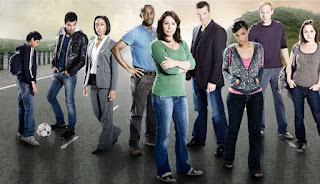
Screen grab from http://www.bbc.co.uk/survivors/

So why, when around two thirds of the UK population wear glasses or contact lenses? Possible reasons:
  • The programme-makers didn't consider glasses cool enough. Unlikely, seeing as Doctor Who often wears specs and he is the sexiest man in the universe (apparently).
  • Wearing glasses puts you at an increased risk in a world "with no society, no police and no law and order". True, someone might be able to sneak up on you if you were busy cleaning your bins, and it could make life very difficult if you happened to break them, but I don't think this can account for the almost total absence of glasses-wearers in the programme.

  • The virus that struck down 99% of the UK population is especially dangerous to the myopic. This seems the most likely explanation - perhaps someone should tell the scientists working on a vaccine (incidentally: why bother, when almost everyone who was susceptible to the virus is now dead?). And this explanation would account for the two elderly folk at the eco-centre: they were wearing reading glasses, and weren't short-sighted at all.

Of course, it could be that the survivors are all wearing contact lenses: but really, in a post-apocalyptic world, would you bother?

"We must defy Dexter's thugs and mount a raid on the supermarket!"
"Why, what do we need: food, fresh water, medicines?"
"No, I'm nearly out of contact lens solution..."


Normal service will be resumed tomorrow.

UPDATE 10.15pm: You can watch the Survivors remake on the BBC's iPlayer.

The perils of daytime TV

Apus here. As a retired wordsmith I'm no longer dealing with solecisms in an engine room. But having spent so many years looking out for them I find it hard not to spoil Mrs Apus's enjoyment of her favourite house-hunting TV programme by repeatedly pointing out that the presenters deserve prosecution for language crimes.

The following ARGHHHH-inducers were noted in no more than five minutes, at which point Mrs A took my pencil away and sent me out for a walk to calm me down:

  • "peaceful and tranquil"
  • "they have lengthy criteria"
  • "it's a place full of local shops"
  • "future plans"
  • "unexpected windfall"

The walk helped.

It's bloody sloppy: carnage and damage

Heard last night while dozing through yet another fly-on-the-wall cop-doc:

Despite the carnage he caused no one was seriously hurt

Ouch! Carnage, as any working hack should know, means widespread slaughter (indeed the word's roots can be traced back to the Latin for flesh). You can't cause carnage without killing people; the miscreant in this case had merely smashed up a few cars while being chased by the police, so what he caused was damage, not carnage.

Is it me, or is this kind of sloppy English becoming the norm as an increasing number of TV stations seek to fill our waking hours with low-rent programming?

AdSpeak

Like most people I do my best to avoid, or at least ignore, TV adverts, but a couple of adman phrases never cease to irritate me.

Manufacturers of painkillers regularly use the phrase: "No headache pill is more effective than..." Translation: "There's a legal limit on the active ingredients we're allowed to put into our pills and, like our competitors, we've complied with the law so apart from the packaging and the price they're all about the same."

And insurers regularly promise: "You could save up to £xxx." Translation: "You might not save a penny; all this advert promises is that there's an upper limit to the potential saving. And that potential saving is the most extreme case we could justify to the Office of Fair Trading."

In the first example the key word is "more" which to Joe Public might be synonymous with "as" but isn't. In the second example the key words are "could" and "up to".

But presumably most people don't pay close attention to the exact meaning of words, which is why advertisers can fool most of the people most of the time.