Photo special: www kat eat kinson co uk

Here's a snap I took a couple of months back of a billboard near my office:

The web address on the billboard advert reads www.kateatkinson.co.uk, with the 'atkinson' in bold

This advert's interesting because of the subtle use of bold in the web address. It's easy to separate www.kateatkinson.co.uk into its component parts:

www
kate
atkinson
co
uk

With www.kateatkinson.co.uk (the unbolded version), the task is much harder and a reader may well come up with (for example):

www
kat
eat
kinson
co
uk


(Kate Atkinson is an English novelist; I think this advert was promoting her latest novel, When Will There be Good News?.)

Photo special: please pass the CV inside

Something lighthearted for Friday afternoon.

This photo was taken by Clutchslip in Sutton high street (in London) a little while back:

A printed sign in a shop window reading 'VACANCY  PLEASE PASS THE CV INSIDE  THANK YOU'

Packs of Skol contain 440ml of alcohol. Really?

From yesterday's Metro, page 2:

Supermarket Asda has been accused of encouraging underage binge-drinking by selling four cans of lager for 90p.

Its packs of Skol, each containing 440ml of alcohol, work out at just 51p a litre.


So each pack contains 440ml of alcohol. Does 'pack' here mean a can, or does it mean the four-pack? If the former, then Metro is claiming that Skol is pure alcohol, or near enough (depending on the size of the can). If the latter, then it would still be around 20-25% alcohol.

I suspect that, actually, Metro is confusing 'pack' with 'can' and 'alcohol' with beer', and that each can contains 440ml of beer.

Here's The Sun's version of the story - and Brand Republic's. Interestingly, neither mentions the alcoholic strength of Skol. Would pointing that out have watered down the power of the story?

And does anyone know off-hand exactly how strong Skol is? I mean regular Skol, not Skol Super or Skol International or anything like that. Cheers!

Unprecedented levels for a litre of fuel

Taken from recent raw copy:

While the price of fuel may have dropped in recent weeks, we’re still at unprecedented levels for a litre of fuel

If the price of fuel is lower than it was a few weeks ago, surely it can't be at an unprecedented high. The precedent was set a few weeks ago. Unless this is an unprecedented low?

(I understand the point the writer is making; I'm just being pedantic. I think I rewrote the sentence, though, because some of our readers are pedantic too.)


The Engine Room, Alexa and Canadians

According to Alexa's traffic rankings, The Engine Room is now one of the top million websites in the world:


However, Alexa also says that 66.7% of our traffic comes from Canada (not true!), so I'm not sure how much faith I put in it...

What's a hotspot not? A hots pot...

A quote from a police spokesman, taken from recent copy:

Freight crime can have an adverse effect on the economy, with businesses staying clear of hotspot areas


So my first question - what's a 'hotspot area'? Is it synonymous with 'hotspot' and therefore an example of redundancy, or is it in some way different to a common-or-garden hotspot? Perhaps a hotspot area contains a number of hotspots, or maybe it's just like a hotspot but larger.

My second question - 'hotspot' or 'hot spot'? The Concise OED prefers the latter, but I'm the only member of our editorial team who agrees.

And the reason I prefer 'hot spot' to 'hotspot' is simply because I always read 'hotspot' as 'hots pot', and so find it breaks my flow. What's the name for when that happens - is it dissonance?

Cripes, Boris, it's Susie Dent again

From Thursday's thelondonpaper:

According to experts, 2008 has already given the English language more than 100 new words, ranging from the common "credit crunch" to "glamping" - to describe posh camping. Top of the list is "Cripes!" meaning surprise or shock, synonymous with Boris Johnson.


Where do I start? We've already had the discussion on whether 'credit crunch' is a word, so I'll leave that to one side. But is BoJo really synonymous with surprise or shock? And who else here knew of 'cripes' (with or without initial cap and exclamation) before 2008?

Thelondonpaper adds:

[Cripes] has joined a list of other words which have been so well-used in the past year they could be included in the Oxford English Dictionary


So only well used words make it into the OED? And 'cripes' isn't in the OED? Anyone have one to hand to confirm this? 'Cripes' is in the Compact Oxford English Dictionary, so it would be utterly shocking if it wasn't in the full OED as well.

And who are these 'experts'? The only one named in the article is Susie Dent, who I'm guessing is on a mission to shift a few copies of her new book.

OUP Word of the Year: credit crunch

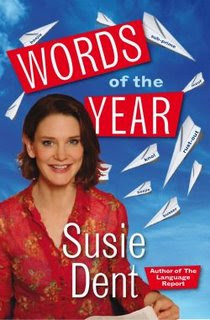
The front cover of Susie Dent's book, Words of the YearOxford University Press emailed The Engine Room this morning to inform us that the OUP UK Word of the Year – "as chosen by Countdown's Susie Dent" – is 'credit crunch'.

You can see Susie pictured here on the front cover of her new book, Words of the Year, which is published by OUP. I suspect some kind of tie-in.

Anyway, I can understand the arguments for 'credit crunch' as word of the year: it's highly topical, in common use, nicely alliterative, and so on.

But there's one very strong argument against: 'credit crunch' isn't a word, as most people understand the term – it's a phrase. A noun phrase, to be more specific.

I suppose that 'OUP Word or Noun Phrase of the Year' doesn't have quite the same ring to it.

(It's probably worth mentioning here that I went for a very appealing job at OUP a few years ago and, shockingly, didn't get it. Not that I'm bitter at all.)


So what would be your word or noun phrase of the year?

Headlines: 'Sark fire blamed on a cleaner'

The most misleading news headline of the day goes to the Metro free paper with:

Sark fire blamed on a cleaner


In reality, the fire that caused £10m of damage to the Cutty Sark last year wasn't caused by a person who cleans – but by an industrial vacuum cleaner that had accidentally been left on for two days. Of course, it is possible that the cleaner had been left on by a cleaner, so to speak.

The Sky News website decided to run with an almost identical (and just as misleading) headline.

And here's some rather more enlightening video footage on the cause of the Cutty Sark fire from Telegraph.co.uk. I've had to change the dimensions to get it to fit on the blog so apologies if it looks a bit squashed or otherwise doesn't display properly: